


Join our newsletter today and receive a special 10% discount code for your next purchase.


Last Updated: October 22, 2026
Quick Summary
A lab grown diamond engagement ring price in the UK typically runs from around £740 for a 0.50ct solitaire to several thousand pounds for larger stones and platinum settings. At Griffin & Co, lab-grown solitaire rings start at £740, with 1.00ct rings around £1,300 to £1,800 in 18K gold. Prices depend on cut, colour, clarity and metal choice.
- Price steps up with carat weight rather than rising in a straight line, because larger rough is scarcer.
- A 0.75ct ring costs around £950 to £1,200 and suits buyers wanting presence without the 1.00ct step.
- Dropping one clarity grade below the top typically saves £150 to £400 with no visible difference.
- Cut is the only grade you should never trade down, as a poor cut cannot be rescued.
- Confirm whether a quote includes VAT, since a £1,500 quote becomes £1,800 at the standard 20% rate.
Table of Contents
- Lab Grown Diamond Engagement Ring Price: What You'll Actually Pay
- 1-Carat Lab-Grown Diamond Price: The Benchmark to Know
- Lab-Grown Diamond Price by Carat: 0.50ct to 2.50ct
- Lab-Grown vs Natural Diamond Price: What the Gap Really Looks Like
- What Drives the Price: Cut, Colour, Clarity and Metal Choice
- How to Choose a Lab-Grown Diamond Without Overpaying
- What's Included in the Advertised Price, and What Isn't
- Budget Planning: Specification Trade-Offs That Protect the Look
- Frequently Asked Questions
Lab Grown Diamond Engagement Ring Price: What You'll Actually Pay
A lab grown diamond engagement ring price in the UK typically runs from around £740 for a 0.50ct solitaire to several thousand pounds for larger stones and platinum settings.
Neither assumption holds. Lab-grown diamonds are chemically and optically identical to mined stones, and the Gemological Institute of America's guidance on lab-grown diamonds confirms they grade on the same four Cs.
At Griffin & Co, our lab-grown solitaire rings start at £740.
1-Carat Lab-Grown Diamond Price: The Benchmark to Know
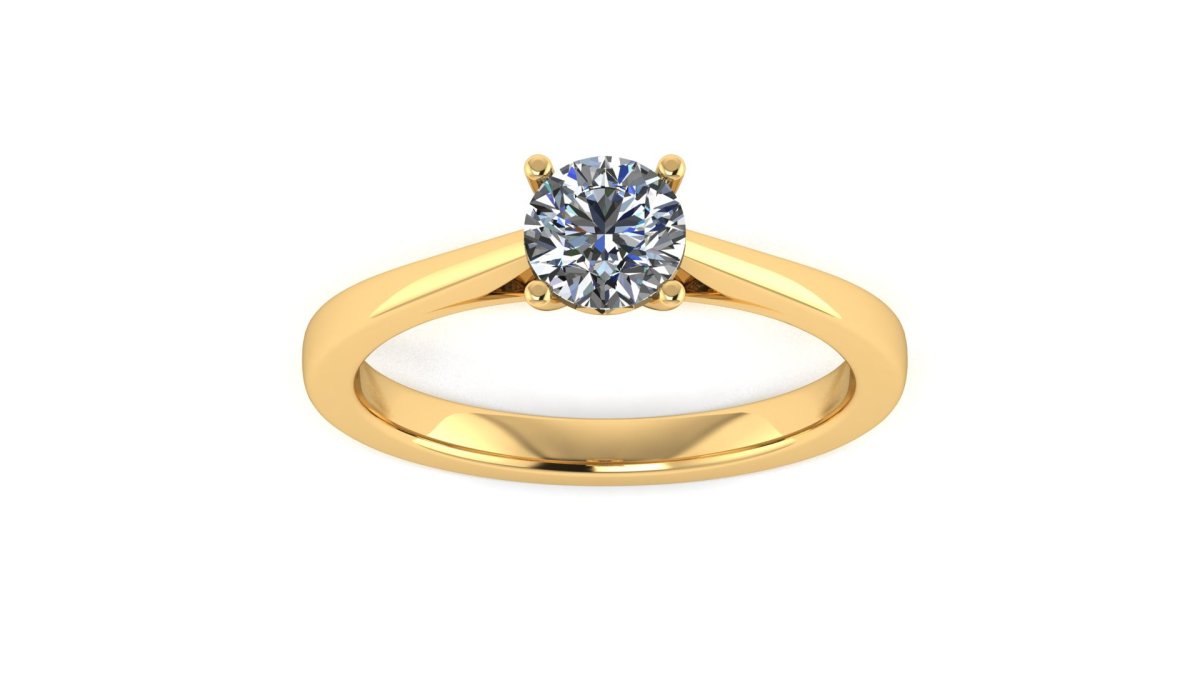
The one-carat stone is the reference point every buyer should understand first, because almost every other price conversation is a multiple or fraction of it. A 1.00ct lab-grown diamond solitaire is the most requested specification we quote, and it sits at the centre of most budget decisions.

Three things set the one-carat price:
- Cut quality, an excellent cut costs more rough and more time, but it is the single biggest factor in how bright the stone looks
- Colour and clarity grades, moving from a mid grade to a top grade adds cost fast, often for differences invisible to the eye
- Metal and setting, platinum adds a meaningful premium over 9ct or 18K gold, and a plain four-claw solitaire is the least expensive way to hold a stone
A common mistake is treating one carat as a fixed price. It isn't. Two 1.00ct rings can differ substantially depending on grading and metal, which is why we quote the whole specification rather than a headline carat figure.
Pro Tip
Ask for the certificate number before you compare quotes. Two rings at the same carat weight can carry very different colour and clarity grades, and the certificate is the only way to compare like for like.
Lab-Grown Diamond Price by Carat: 0.50ct to 2.50ct
Price does not rise in a straight line with carat weight. It steps up, and the steps matter more than the slope.
| Carat Weight | Typical Complete Ring Price (18K Gold) | What It Looks Like | Typical Trade-Off |
|---|---|---|---|
| 0.50ct | From around £740 | Delicate, understated | Best value; leaves budget for metal upgrades |
| 0.75ct | Around £950 to £1,200 | Noticeably larger than 0.50ct | The sweet spot for buyers who want presence without the 1.00ct step |
| 1.00ct | Around £1,300 to £1,800 | The classic benchmark | Balances size and specification |
| 1.50ct | Around £2,000 to £2,800 | Visibly substantial on the hand | Clarity becomes more important as the stone grows |
| 2.00ct to 2.50ct | From around £3,000 upward | A statement stone | Demands higher clarity to avoid visible inclusions |
These are guide prices for the specification described, not fixed quotes. Two 1.00ct rings can differ by several hundred pounds depending on grading and metal, which is why we quote the whole specification rather than a headline carat figure.
How the specification moves the price at each carat weight:
- Cut. An excellent cut costs more rough and more time, but it is the single biggest factor in how bright the stone looks. At 1.00ct, moving from a good cut to an excellent cut typically adds £150 to £300, money well spent because it is visible across a room.
- Colour. At 0.50ct, colour differences are hard to see; at 2.00ct they become obvious. Dropping one colour grade at the smaller sizes saves £100 to £200 with no visible effect; at the larger sizes the saving is smaller because buyers rightly protect colour.
- Clarity. This is where buyers overspend most. Inclusions graded at the top end are usually invisible without a loupe. Dropping one clarity grade below the top typically saves £150 to £400 depending on carat, with no difference the eye can detect in a well-cut stone.
Our radiant, princess and cushion solitaires are each offered in 0.50ct, 1.00ct and 2.50ct sizes, so you can see the same design at three points on the curve. The practical lesson: if you want size, spend on carat first and accept a slightly lower clarity grade. If you want sparkle, spend on cut and keep the carat modest.

Pro Tip
Ask for a written quote that lists carat, cut, colour, clarity and metal separately. A single headline price hides which variable is driving the cost, and that is the number you need to negotiate or adjust.
Lab-Grown vs Natural Diamond Price: What the Gap Really Looks Like
The gap is large, and it has widened as lab-grown production has scaled.
What most guides miss is what the gap does to your decision. A lab-grown stone lets you buy a visibly larger, better-cut diamond for the same money, or the same diamond for considerably less.
The honest limitation: mined diamonds have a long-established secondhand market, and lab-grown resale values are generally lower and less predictable. If resale is central to your thinking, buy accordingly.
Watch Out
Do not buy a lab-grown diamond expecting it to behave like a financial asset. Treat the purchase as jewellery, not investment, and you will make a clearer decision on specification and budget.
What Drives the Price: Cut, Colour, Clarity and Metal Choice
Four variables do almost all the work on a lab-grown ring's price, and understanding their order of importance is how you avoid paying for things nobody can see.
Cut is the most important and the one to protect.
Then there is metal. Our solitaire designs are available in yellow gold, white gold, rose gold and platinum.
Radiant Cut Lab Diamond Solitaire Engagement Ring →
Certification ties it together.
How to Choose a Lab-Grown Diamond Without Overpaying
Choosing well comes down to spending in the right order. Most buyers do it backwards, chasing a clarity grade first and compromising on cut, which is the one thing you actually see across a room.
Here is the sequence we recommend:
- Set your total budget including metal, sizing and any future servicing
- Pick the cut you want and refuse to compromise on it
- Choose carat based on the look you want on the hand
- Drop clarity one grade below the top if it saves money with no visible difference
- Confirm certification and check the report matches the stone
- Settle the metal last, once the stone is chosen
A useful check: view the stone in person or through a proper visualisation before committing. Griffin & Co's online ring builder produces a visualisation of your design within 24 hours.
Key Takeaway
Cut is the only grade you should never trade down. Colour and clarity can flex by a grade with little visible effect; a poor cut cannot be rescued by anything.
What's Included in the Advertised Price, and What Isn't
The advertised price is rarely the whole story, and this is where buyers get caught out. Knowing what sits inside the figure protects you from a surprise at checkout.
Typically included in a made-to-order ring price:
- The certified centre diamond, with its grading report
- The setting and band in your chosen metal
- Standard sizing within a normal range (usually a few sizes either side of the quoted size)
Typically not included, or worth confirming before you commit:
- VAT. Under HM Revenue & Customs guidance on VAT for goods and services, VAT treatment depends on the circumstances of the sale. Most retail sales of rings to consumers are standard-rated, so confirm whether the quoted figure is inclusive or exclusive of VAT, a £1,500 quote that excludes VAT becomes £1,800 at the standard 20% rate. Ask directly: "Is that price inclusive of VAT?"
- Resizing outside the standard range. Resizing a ring by more than a few sizes can require remaking the band, and that is chargeable. Confirm the free-resizing limit in writing.
- Engraving or custom modification. Personalisation is usually priced separately.
- Insurance valuation paperwork. A separate valuation for insurance purposes may carry a fee; your grading certificate is not the same document.
The certification question. An independently certified stone with a documented grading report is worth more than an uncertified one of the same appearance, because the grade is verifiable rather than claimed.
The written breakdown. Ask for a written breakdown of what the quote covers before paying a deposit. Any reputable jeweller will provide one.
Watch Out
Do not assume a quoted price includes VAT, delivery or a warranty. In the UK, the difference between an inclusive and exclusive quote can be hundreds of pounds, and the only way to know is to ask for it in writing.
Budget Planning: Specification Trade-Offs That Protect the Look
Budget planning is not about spending less. It is about spending where the eye notices. Get the trade-offs right and a modest budget produces a ring that looks far more expensive than it was.
The trade-offs that work:
- Trade clarity for carat. A slightly lower clarity grade in a larger stone reads as more impressive than a flawless small one.
- Trade colour for cut. Near-colourless with an excellent cut outperforms top-colour with a mediocre cut every time.
- Trade platinum for gold. If the metal is eating your stone budget, 18K or 9ct gold frees up money for the diamond.
- Trade size for setting quality. A well-made four-claw solitaire in a modest carat beats a large stone in a poorly finished setting.
The trade-offs that don't work: cutting cut quality, skipping certification, or stretching to a carat weight that leaves nothing for the setting.
If you are unsure where your budget lands, a conversation with a jeweller beats guessing.
Frequently Asked Questions
How much does a lab-grown diamond engagement ring cost?
At Griffin & Co, ready-to-order solitaire designs start at £740 for a round-brilliant or cushion-cut lab-grown diamond, £860 for a princess cut and £920 for a radiant cut. Those prices are for the base specification and metal; larger carat weights, higher clarity grades and platinum change the figure. A 1-carat lab-grown diamond engagement ring price typically sits in the low-to-mid four figures once you move beyond entry specifications, so compare like-for-like carat, colour and clarity before judging any quote.
Is a lab-grown diamond engagement ring cheaper than a mined diamond ring?
Yes, substantially. Lab-grown stones are produced rather than mined, so the lab-grown vs natural diamond price gap is wide at every carat weight. The saving is largest on bigger stones, which is why a 1.50ct or 2.00ct lab-grown diamond can cost less than a much smaller natural equivalent. Put the difference into cut quality, a better setting or a metal you prefer rather than assuming a bigger carat is automatically the better buy.
Are lab-grown diamonds real diamonds?
They are real diamonds in the chemical and optical sense: the same carbon crystal structure, the same hardness and the same sparkle. The difference is origin, not material. Ask for independent certification from a recognised grading laboratory so cut, colour, clarity and carat are stated by someone other than the seller. Certification is the single most useful check when you compare lab-grown diamond prices across different rings.
Do lab-grown diamond engagement rings hold their value?
Resale values for lab-grown diamonds are lower and less predictable than for natural stones, largely because production costs keep falling and supply keeps rising. Treat an engagement ring as a piece you wear and enjoy, not an investment. If resale matters to you, buy the design and specification you love, keep the certificate and original paperwork, and factor in that the metal, setting and craftsmanship hold a steadier share of the value than the stone itself.
Buying an engagement ring involves more variables than most people expect, and the pressure to get it right first time is real. Griffin & Co removes most of that pressure: we specialise in lab-grown diamonds, build every ring to order, and let you visualise your design within 24 hours before you commit. Book a private consultation and we will walk you through specification, metal choice and budget until the decision feels straightforward.